05.06.2026 Paper: Experimental Setup for In Situ Determination of Conductivity–Porosity–Pressure Relationships during Compression of Solid Electrolytes and of Cathode Active Materials
Vanessa Miß, Fabio Lange, Stefan Staubitz, Bernhard Roling
Deparment of Chemistry and Marburg Center for Quantum Materials and Sustainable Technologies (mar.quest), University of Marburg, 35032 Marburg, Germany
Abstract
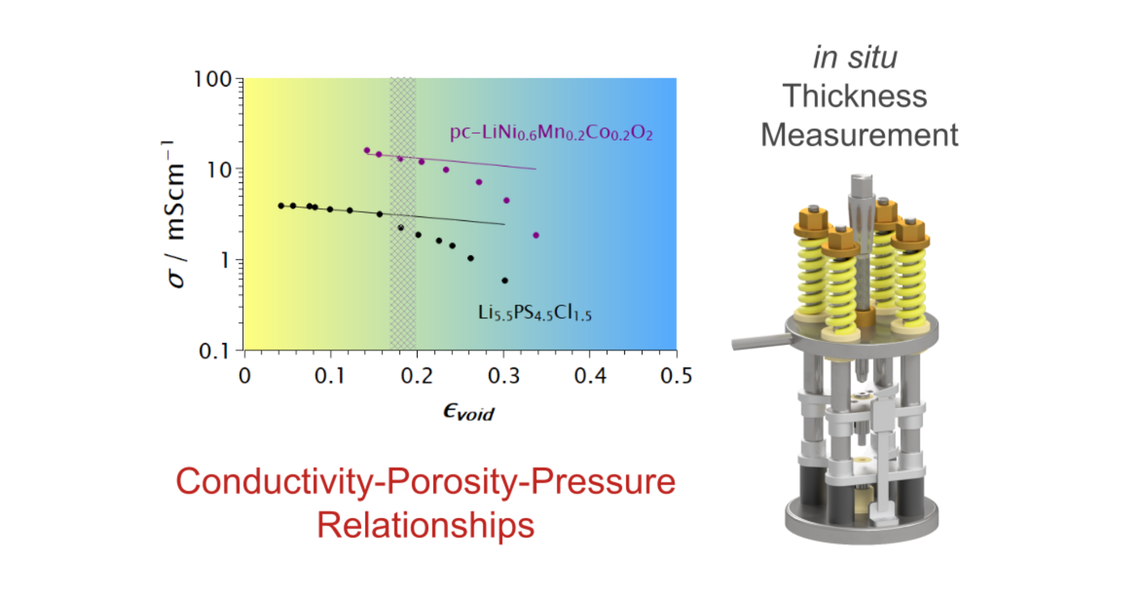
Composite cathodes of all-solid-state batteries (ASSBs) consist of cathode active material (CAM) particles and solid electrolyte (SE) particles. Since ASSBs are typically cycled under external pressure, pressure-dependent electronic transport in the CAM phase and ionic transport in the SE phase play an important role in the battery performance. In order to better understand the relationship between conductivity, porosity, and pressure during the compression of particles, we have built a test station for simultaneous in situ measurements of conductivity and porosity under variable pressure. We illustrate the design of this test station, and we show exemplary results for the microcrystalline solid electrolyte Li5.5PS4.5Cl1.5 and for the polycrystalline cathode active material LiNi0.6Mn0.2Co0.2O2. The results indicate two distinct porosity regimes: a high-porosity regime, with the conductivity being governed by the interfacial contacts between the particles, and a low-porosity regime with the conductivity being governed by the void space between the particles.
Read the full paper in Appl. Mater. Interfaces 2026, XX, XXX by American Chemical Society.