Main Content
Bachelor/Master projects
Are you interested in our research? That makes us happy! Whether you prefer to produce solar cells yourself, tinker with measurement setups or simulate physical processes, we are sure to find the right thing for you. Please contact us for possible topics for bachelor's, master's or state examination theses.
Possible Bachelor/Master Projects:
Optimization of Wide-Bandgap Perovskite Solar Cells for High-Efficiency Tandem Photovoltaics (master thesis)
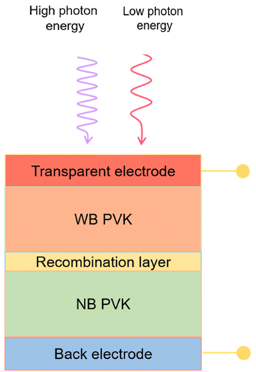
Picture: Gülüsüm Babayeva Project Description
Wide-bandgap (WBG) perovskite absorbers are key components for next-generation tandem photovoltaic devices, as they enable efficient utilization of the solar spectrum when combined with low-bandgap bottom cells. However, WBG perovskite solar cells often suffer from significant open-circuit voltage Voc losses, primarily originating from non-radiative recombination at critical interfaces, particularly at the perovskite/electron-transport-layer contact.
This project aims to investigate and mitigate these voltage losses through systematic interface engineering and the development of ultrathin interlayers. Starting from an established WBG perovskite absorber composition, different interface modification strategies will be implemented to suppress interfacial recombination and improve charge extraction. Particular focus will be placed on the interaction between the perovskite absorber and fullerene-based electron transport layers.
By optimizing interface properties and fabrication parameters, the work aims to establish a reproducible processing route for high-performance WBG perovskite solar cells. The resulting devices will provide an improved platform for integration into tandem photovoltaic architectures, contributing to the development of stable and high-efficiency tandem solar cells.
Main Tasks
• Fabrication of wide-bandgap perovskite solar cells
• Investigation of Voc loss mechanisms at the perovskite/ETL interface
• Implementation of interface engineering strategies
• Characterization of photovoltaic devices using optical and electrical techniques (JV, PL,UV-Vis, EQE)
• Assessment of WBG device suitability for integration into tandem solar cell architectures
Methods & Tools
• Spin coating and automated deposition (Spinbot)
• Thermal evaporation and sputtering
• Atomic Layer Deposition (ALD) for interlayer formation
• Glovebox-based thin film fabrication
• Standard solar cell characterization techniques
Preferred Background
• Physics, chemistry, materials science, or related disciplines
• Interest in thin-film photovoltaics and interface engineering
• Experience with glovebox processing or solar cell fabrication is beneficial
• Ability to work independently within a collaborative research environment
Contact person: Gülüsüm Babayeva
Formation Mechanism of Low-dimensional Perovskite Structures on 3D Perovskite Films (bachelor thesis or advanced internship in the field of physics/chemistry)
Project description
Within a 6-10 week work phase, the formation mechanism of low-dimensional perovskite structures (LDPs) that arise on three-dimensional (3D) perovskite films will be investigated. The aim is to gain a better understanding of the formation, structure, and properties of LDPs, which are of great importance for the passivation of surfaces in perovskite solar cells.The work involves the production of thin perovskite films using established wet chemical processes in glove boxes. The samples are then characterized using various spectroscopic and microscopic methods. The focus is on spectroscopic and spatially resolved photoluminescence, supplemented by other analytical techniques such as UV-Vis absorption spectroscopy, X-ray diffraction (XRD), and scanning electron microscopy (SEM). Depending on the progress of the project, there is also the possibility of manufacturing complete perovskite solar cells and investigating the effect of LDPs in solar cells by means of current-voltage measurements.
Requirements:
We are looking for a motivated student with an interest in experimental laboratory work and physical-chemical issues. You should enjoy practical activities, be interested in chemical processes, and have a certain tolerance for frustration.
Contact person: Malwine Lühder
Electro-Optical Simulation of Perovskite Solar Cells (SETFOS) (master thesis)
Project Description
This project focuses on modelling single-junction and monolithic tandem perovskite solar cells using SETFOS. The work includes simulating light absorption, emission, scattering and optical losses while accounting for roughness, crystallinity and parasitic absorption in the different layers. On the electrical side, you will model electron, hole and ion transport to reproduce JV curves, EQE, recombination pathways, ion migration and hysteresis. Targeted characterisation experiments, such as thickness variations and interlayer engineering, will be carried out to validate and refine the developed models.
Main Tasks
You will develop and test optoelectronic models in SETFOS, implement and optimise material parameters, simulate complete device stacks and compare the simulation results with experimental data to improve the physical accuracy of the models.
Learning Outcomes
By completing this thesis, you will gain a solid understanding of the optical and electrical processes governing perovskite solar cells, practical experience with drift–diffusion and transfer-matrix simulations, and the ability to link modelling with experimental observations for device optimisation. You will also strengthen your scientific communication skills through regular discussion and presentation of your results within the team.
Target Group / Requirements
This project is aimed at Master students in physics who have prior knowledge of semiconductor and perovskite solar cell physics, basic programming and computational skills, and an interest in combining theoretical modelling with experiments. Independent and reliable working habits are expected.
Contact person: Christopher Janas